






 Trap
 Normal
Dice It
Archetype:
Dice
View:
4098
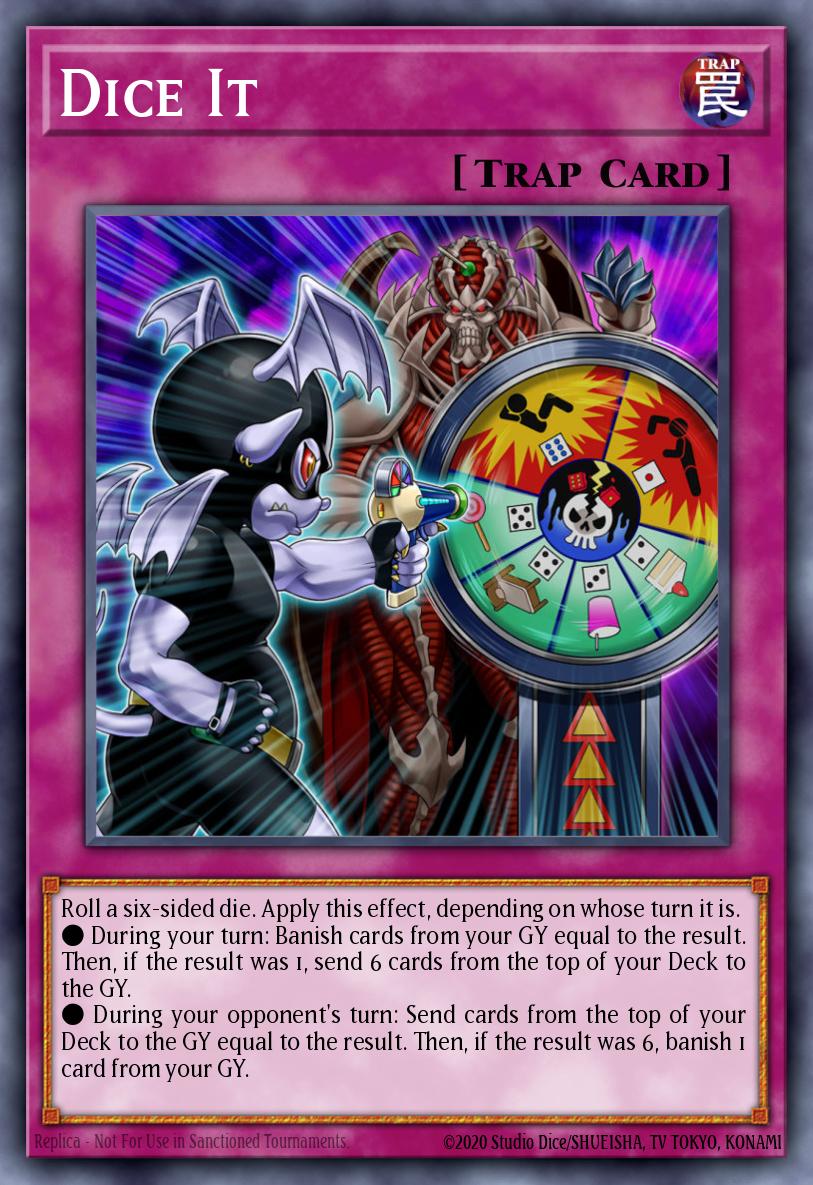
Roll a six-sided die. Apply this effect, depending on whose turn it is. ● During your turn: Banish cards from your GY equal to the result. Then, if the result was 1, send 6 cards from the top of your Deck to the GY. ● During your opponent's turn: Send cards from the top of your Deck to the GY equal to the result. Then, if the result was 6, banish 1 card from your GY.
Dice It — Power Evaluation
Final Score: 40 ± 8 · Confidence: Medium
- Intrinsic: 41 · Deck: 40 · Meta: provisional
- Primary role: Utility
Why it scores here
Dice It is a random-result Trap whose text only trades resources: on your turn it banishes GY cards equal to the roll, and on your opponent's turn it sends cards from the top of your Deck to the GY equal to the roll. It gives no negation, removal, or board, and a Trap cannot be material. The 48-deck sample (36 of them Phantom Knights) earns accessibility credit, but deck inclusion does not raise the score because the card does not convert into winning value by itself. Without recorded combos, combo conversion rests on the text alone.
Axis scores
| Axis | Score | Evidence |
|---|---|---|
| Accessibility | 55 | Appears in 48 recent decks at an average of 1.69 copies, so it is drawn regularly; no searcher or combo route is recorded (observed). |
| Combo & Conversion | 25 | No combo boards are recorded, and the text only banishes and mills, so it builds nothing on its own (inferred). |
| Resource Economy | 30 | Both effects spend GY or Deck cards with no return, and the roll of 1 adds a further 6-card self-mill (verified). |
| Effect & Interaction | 10 | The text has no negation, destruction, or search effect; the only interaction is a random mill (verified). |
| Material Utility | 5 | It is a Trap Card and cannot be used as a material body (verified). |
| Resilience & Flexibility | 35 | A set Trap with no redundant route, and the random roll can waste its effect (inferred). |
| Deck-Building Efficiency | 60 | No garnet or lock restriction appears in the text, and the copy limit is assumed to be 3; the cost is self-mill pressure on deck-out (inferred). |
Calculation
Weight profile: Utility default weights; no secondary role blend. Intrinsic ≈ 41, Deck ≈ 40, Meta = provisional. Modifiers: none. Final formula: 0.40*Intrinsic + 0.60*Deck
Strengths
- Plays in 48 recent decks spread across 8 archetypes
- Its text is not tied to one archetype
Weaknesses
- No card advantage: its effects cost cards and return none
- Self-mill on the opponent's turn and banish on yours add deck-out and resource pressure
- No negation or removal, and it cannot be used as material
- 75% of sampled decks are Phantom Knights, so real portability is weaker than the archetype count suggests
Counters / choke points
- An opponent's negation of the set Trap stops the effect before it resolves (inferred)
- A thin GY makes the banish cost fail on your turn (inferred)
Best use
Utility Trap with GY and Deck resource filler, not a stand-alone threat. Decks: Phantom Knights (observed in 36 of 48 sampled decks).
Evidence & gaps
- Verified: Card text: your-turn GY banish equal to the roll, plus a 6-card self-mill on a roll of 1; opponent-turn Deck-to-GY mill equal to the roll, plus a GY banish on a roll of 6; Card type is Trap Card, so it cannot be used as material; 48 recent decks with an average of 1.69 copies
- Observed: 36 of 48 decks are Phantom Knights (75%); Strong co-occurrence with Phantom Knights partner cards (co-deck counts of 36 or more); this is correlation, not proof of causation
- Inferred: Offers no negation, removal, or board, so it converts resources into little winning value; Random roll means the outcome of the effect is not reliable
- Data gaps: No combos supplied, so combo conversion is text-only inference No banlist token; copy limit assumed to be 3 No usage statistics (StatisticsCard); inclusion is inferred from the 48-deck sample only The archetype field says 'Dice' but 75% of decks are Phantom Knights; the card's intended home is unclear No rulings supplied for the die roll or the turn-based effects